
Experts of both the countries will meet by mid-September 2016 to further discuss the modalities for the reciprocal bilateral implementation of AEOI between India and Switzerland with a view to reaching an agreement at the earliest, possibly by the end of the year

'Begin with a small investment, observe performance, then scale up gradually.'

Ask rediffGURU and tax expert Mihir Tanna your income tax-related questions.

Armed with automatic information exchange pact with the US, government on Thursday asked persons holding undisclosed offshore assets to declare them before September 30 as it would be difficult to hide unaccounted assets in future.

The finance ministry on Saturday asserted that Indian customer deposits in Swiss banks have fallen since 2019, but said it is seeking details from Swiss authorities on the relevant facts along with their view on possible reasons for changes in the funds parked by individuals and entities in 2020. In a statement, the ministry said the deposits have halved but did not give numbers. Quoting data from Switzerland's central bank, PTI had reported on June 17 that funds parked by Indian individuals and firms in Swiss banks, including through India-based branches and other financial institutions, jumped to a 13-year high of 2.55 billion Swiss francs (over Rs 20,700 crore) in 2020 on a sharp surge in holdings via securities and similar instruments, though customer deposits fell.

Funds parked by Indian individuals and firms in Swiss banks, including through India-based branches and other financial institutions, declined by 11 per cent in 2022 to 3.42 billion Swiss francs (nearly Rs 30,000 crore), annual data from Switzerland's central bank showed on Thursday.

Ask rediffGURU and tax expert Mihir Tanna your income tax-related questions.

Total market funds are ideal for long-term investors who prefer a simple, hands-off approach, making them suitable for those unwilling to manage multiple funds.

According to a senior official, Sebi has written to various stakeholders under its jurisdiction with regard to the requirement of FIs to report under CRS.

The income-tax (I-T) department is working on integrating the new e-filing portal with stock exchanges to help tax authorities track trade transactions, including futures and options. The integrated system will look at discrepancies between the data disclosed by an assessee and match it with data fetched from stock exchanges, using artificial intelligence, said two officials in the know. This will help detect and red-flag such matters, particularly those related to non-filers of income-tax return (ITR).

FATCA will facilitate flow of financial information between countries.

He said this in Parliament rebutting reports last month, which quoted the Swiss National Bank, the country's central bank, as saying in its annual report that Indian deposits had risen by 50 per cent in 2017.

The total money of Indians fell by 45 per cent during 2016 to CHF 675.75 million, marking the biggest ever yearly decline in such funds.

India and the US inked a tax information sharing agreement under FATCA which will enable automatic exchange of financial information.

Occasionally, a whistle-blower releases sensitive financial data.

Indians having undisclosed income in the United States (US) may face proceedings under Black Money (Undisclosed Foreign Income and Assets) and Imposition of Tax Act, 2015, this financial year. Also, those named in global leaks may be searched, show-caused, and prosecuted, according to the FY23 internal action plan of the Central Board of Direct Taxes (CBDT). The CBDT has rolled out an aggressive target and timeline to investigate tax evasion matters, especially those involving undisclosed foreign assets.

In its effort to unearth black money stashed away abroad, India has received data on over 24,000 instances of alleged tax evasion and dubious funds which has been detected in foreign shores in the last financial year.

Funds parked by Indian individuals and firms in Swiss banks, including through India-based branches and other financial institutions, jumped to a 14-year-high of 3.83 billion Swiss francs (over Rs 30,500 crore) in 2021 on a sharp surge in holdings via securities and similar instruments while customer deposits rose as well, annual data from Switzerland's central bank showed on Thursday.

Switzerland has been making efforts to strengthen its bilateral cooperation with India .

SIP top-ups are especially beneficial for young investors, who may start with a small SIP installment and grow it over their working careers, says Dwaipayan Bose.

'If you see another 1000-point correction, people may start panicking.'

The impact of currency depreciation can also be mitigated by holding a portion of your investment portfolio in dollar-denominated assets.

Funds parked by Indian individuals and firms in Swiss banks, including through India-based branches and other financial institutions, jumped to 2.55 billion Swiss francs (over Rs 20,700 crore) in 2020 on a sharp surge in holdings via securities and similar instruments, though customer deposits fell, annual data from Switzerland's central bank showed on Thursday. The increase in aggregate funds of Indian clients with Swiss banks, from 899 million Swiss francs (Rs 6,625 crore) at the end of 2019, reverses a two-year declining trend and has taken the figure to the highest level in 13 years. It stood at a record high of nearly 6.5 billion Swiss francs in 2006, after which it has been mostly on a downward path, except for a few years including in 2011, 2013 and 2017, as per the Swiss National Bank (SNB) data.

Chaos in Parliament threw a spanner in the government's efforts to revive the economy and kick-start reforms.
A new framework has been put in place for automatic exchange of information between Switzerland and India to help check the black money menace with effect from January 1, 2018. The funds held by Indians through fiduciaries alone used to be in billions till 2007 but began falling after that amid fears of regulatory crackdown. It is now at second-lowest level in 20 years.

These individuals largely include businessmen associated with companies, including the dummy ones, in sectors ranging from real estate, financial services, technology and telecom to paints, home decoration, textiles, engineering goods, gems and jewellery. Several of these persons and their companies are said to be based in Kolkata, Gujarat, Bengaluru, Delhi and Mumbai.

Compliance window for those with undisclosed income abroad to come clean by paying 30 per cent tax and 30 per cent penalty

Financial institutions at the risk of US sanctions as sharing of documents on SC directive amounts to violation of existing agreements.
Swiss authorities have always maintained that assets held by Indian residents in Switzerland cannot be considered as 'black money' and they actively support India in its fight against tax fraud and evasion.

As probe into suspected black money stashed abroad by Indians gathers steam, banks in Switzerland are running from pillar to post to safeguard their interest.

This is the first time that this important nodal national agency for economic intelligence has obtained data on suspected offshore stash of Indians as, till now, such information was only received by the exclusive wing of the Central Board of Direct Taxes.

Tokenisation acts as an additional layer of security as it masks sensitive card data such as the 16-digit account number, expiry date and security code. However, the security level of the app and the customer's mobile itself also needs to be taken into consideration, say experts. Nikhat Hetavkar explains the whole idea of tokenisation, how it is enabled, its impact on card transactions and related security guidelines.

To combat terror financing, India and the US committed to work together to check illicit money transfers.

The Indian money in Swiss banks had fallen by 45 per cent in 2016, marking their biggest ever yearly plunge, to CHF 676 million (about Rs 4,500 crore) -- the lowest ever since the European nation began making the data public in 1987.

Rejecting the charge that the National Democratic Alliance has done a U-turn on disclosure of names of black money holders, Finance Minister Arun Jaitley has said the government will not be pushed into an act of adventurism and jeopardise the chances of getting cooperation of other countries in future.

Mutual funds, as experts and custodians of another set of retail investors' savings, play a speculative game they are neither supposed to nor equipped to do, cautions Debashis Basu.

Concluding the three-part series, Paranjoy Guha Thakurta says that the black money law is likely to fail because of the ineptness of India's investigative and enforcement agencies.
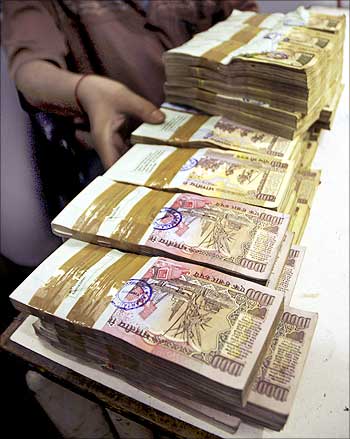
A stream of people, including those from Rajasthan and Karnataka, walked into the only designated office before the closure of the one-time compliance window.

The RBI panel has also recommended a government-sponsored 'fund of funds' of Rs 10,000 crore to support the venture capital and private equity firms investing in the MSME sector.

'Tax dodging through tax havens is one of the ways multinational corporations and the super-rich in India are using to evade taxes.'
